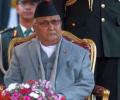
He claimed that India built a Kali temple, created 'an artificial Kali river' and 'encroached the Nepalese territory through deploying the Army' at Kalapani. The river defines the border between the two countries.

Beijing views the India-based Dalai Lama, the spiritual leader of the Tibetan people, as a separatist trying to split the Himalayan region from China.

'The PLA has continued to do exercises and drills and recently carried out air exercises with fighter jets.'

The government has also relaxed certain rules to cut delays in military purchase like allowing the three services to procure required weapons and equipment from a single vendor, the sources said.

India said a new mechanism will be set up for issues relating to trade and investment.
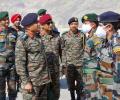
'China is playing the big global game.' 'Their ambitions lie far beyond the Line of Actual Control.'

One thing Beijing must understand is that India is not obsessed with being a threat to China but only wants a rightful place for itself in the world, says Sanjeev Nayyar.

' if Pakistani terrorists can attack states and regions which are far removed from Kashmir, we have got to recognize that there is a bigger problem out there'

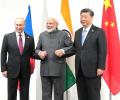
'Russia is the only country that can act as facilitator for any eventual Chinese-Indian rapprochement,' points out Ambassador M K Bhadrakumar.
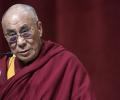
China is worried about the situation post the Dalai Lama and that his reincarnation could surface in Arunchal Pradesh, a region it claims as its own, but which is part of the Indian Republic, says former RA&W Additional Secretary Jayadeva Ranade.
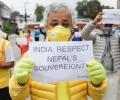
His visit comes ahead of the upcoming official trip of Indian Army chief Gen M M Naravane to Nepal in the first week of November. Goel called on Prime Minister Oli at his official residence at Baluwatar on Wednesday evening, the premier's press advisor Surya Thapa told PTI.
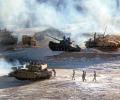
'The Chinese are only about 160-170 km behind.' 'It will not take much time for them to bring their troops back, considering that they have better infrastructure -- and the weather is now favourable.' 'They can move in much faster as the terrain favours them.'

'We can't be outliers. We can't be bystanders. We have to be players.' 'The Taliban also need India to balance the winners in this game.'

The Chief of Army Staff is scheduled to hold extensive talks with the top civilian and military brass of Nepal including his counterpart General Purna Chandra Thapa on a range of key issues such as further boosting the management of the nearly 1,800 km-long border between the two countries.

'Building on the potential for closer ties is the changing narrative in each country about the other. The Chinese narrative on India has become significantly more positive over the past few years,' says Walter Andersen and Zhong Zhenming.

Claude Arpi gives a fascinating firsthand account of the Dalai Lama's arrival in Tawang in March 1959 and explains why he will once again receive a grand welcome, whether Beijing likes it or not.
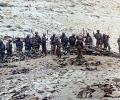
Jaishankar made these comments against the backdrop of the over five-month-long border standoff between India and China in eastern Ladakh where each side has deployed over 50,000 troops.
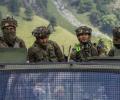
'A breakthrough in eastern Ladakh leading to disengagement and creation of a buffer zone will obviate the need of military deployment through the winter months ahead,' notes Ambassador M K Bhadrakumar.

An international tribunal in the Hague has ruled in favour of the Philippines.

The External Affairs Minister said the Wuhan informal summit was held without any agenda and without having any objective to discuss any specific issue.

The Ministry of External Affairs (MEA) spokesperson Anurag Srivastava said complete disengagement requires re-deployment of troops by each side towards their regular posts on their respective sides of the Line of Actual Control(LAC) and this can be done only through mutually agreed actions.

'The Indian army is a professional army. They can handle such a situation'

India and China on Wednesday signed in all nine agreements, including the Border Defence Cooperation Agreement and one on strengthening cooperation on trans-border rivers, after restricted and delegation-level talks that lasted over two hours as Prime Minister Manmohan Singh and Premier Li Keqiang met for the second time this year for talks which the Indian leader described as "fruitful and productive".

For the first time, the Chinese military on Thursday acknowledged last year's incursion at the DepsangValley in Ladakh region and said such incidents occurred due to different perception about the Line of Actual Control.
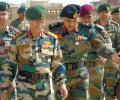
In his initial remarks, Army Chief General M M Naravane briefed the commanders about the overall situation following which detailed discussions on the matter took place, the sources said.

President Xi Jinping's visit may put relations between India and China on a new trajectory

#TwitterBan was trending on Twitter with almost 17,000 tweets.

Prime Minister Manmohan Singh has said that commitment by Indian and Chinese leaderships to maintain peace and tranquillity at borders pending boundary settlement is an important guarantor for further progress in Sino-Indian ties, particularly growth of 2.5 billion people.

In the review meeting, Singh told the top military brass to continue to deal with the situation in eastern Ladakh and other areas with "firmness".

'He is psychologically preparing the PLA and the Chinese public to avoid a loss of face.'
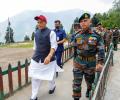
There seems to be a desire for opacity when it comes to confronting China, points out Aakar Patel.

India has already mobilised fighter jets and sent thousands of additional army troops to forward locations along the border with China after 20 Indian Army personnel were killed in a brutal attack by Chinese troops in eastern Ladakh's Galwan Valley on June 15.
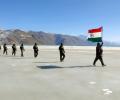
'India's challenge is status quo ante. China's challenge is a face-saving exit'

The visit comes a week after 20 Indian Army personnel were killed in a brutal assault by the Chinese military in Galwan Valley which escalated the border tension.

External Affairs Ministry Spokesperson Anurag Srivastava said India is committed to resolve all issues through dialogue, noting the way ahead to address the issue is negotiations.

'The hardliners in Delhi are in for a big disappointment,' predicts Ambassador M K Bhadrakumar.

It is the first highest level face-to-face meeting between the two sides after the border row escalated in eastern Ladakh in early May.
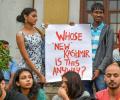
The Supreme Court said on Thursday the surrender of Jammu and Kashmir's sovereignty to India was "absolutely complete" with the accession of the former princely state in October 1947, and it was "really difficult" to say that Article 370 of the Constitution, which accorded special status to the erstwhile state, was permanent in nature.
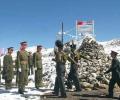
The two armies had mutually decided not to resort to use firearms during face-offs in sync with provisions of two agreements on border management.
